
80 years of Australians’ share ownership
By Jason Beddow (Managing Director) and Meredith Hemsley (Head of Communications and Investor Relations). First published in the Australian Shareholders' Association's Equity magazine.
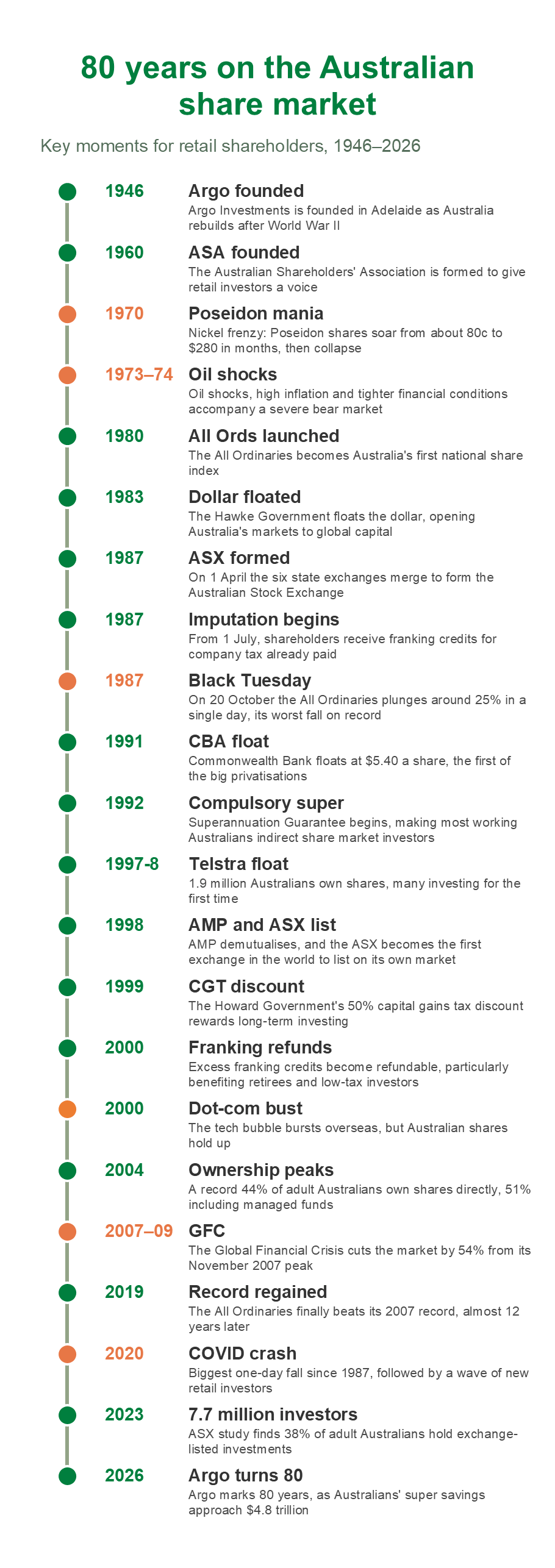
In 1946, Argo Investments was founded in Adelaide to provide everyday South Australians with the opportunity to invest in the Australian share market. To mark Argo’s 80th anniversary this year, we reflect on the factors that have driven the growth of publicly listed share ownership among Australians over the past eight decades.
Almost 40% of Australians own investments listed on the Australian Securities Exchange (ASX), placing Australia among the world’s leaders in share ownership. When you include shares held in superannuation funds, almost every working Australian has a stake in the local share market.
A nation of shareholders
However, this wasn’t always the case. When Argo was founded in 1946, share market investing was the preserve of the wealthy and well-connected. Part of the rationale for establishing Argo was to give ordinary South Australians, including pastoralists and war widows, ready access to a diversified portfolio of Australian companies to invest their savings.
Widespread retail share ownership is a relatively recent phenomenon spurred by several important developments, including regulatory changes, tax reforms, a series of large privatisations and increased access via online platforms.
For much of the last century, investors bought shares exclusively through brokers, often by personal introduction, on trading floors closed to outsiders. Symbolically, in 1960, the Sydney Stock Exchange, which later merged into the Australian Securities Exchange (ASX), opened its public and media galleries for the first time. As the ASX describes it: “people could watch the ‘chalkies’ at work, thus removing the secrecy … and the perception that share trading was an elite activity.”
In the same year, the Sydney Stock Exchange, in conjunction with the Department of Education, began running introductory courses on understanding the share market, and the Australian Shareholders’ Association was formed to give retail shareholders a voice, protect their rights and advance investment education.
Share ownership increases, slowly, then sharply
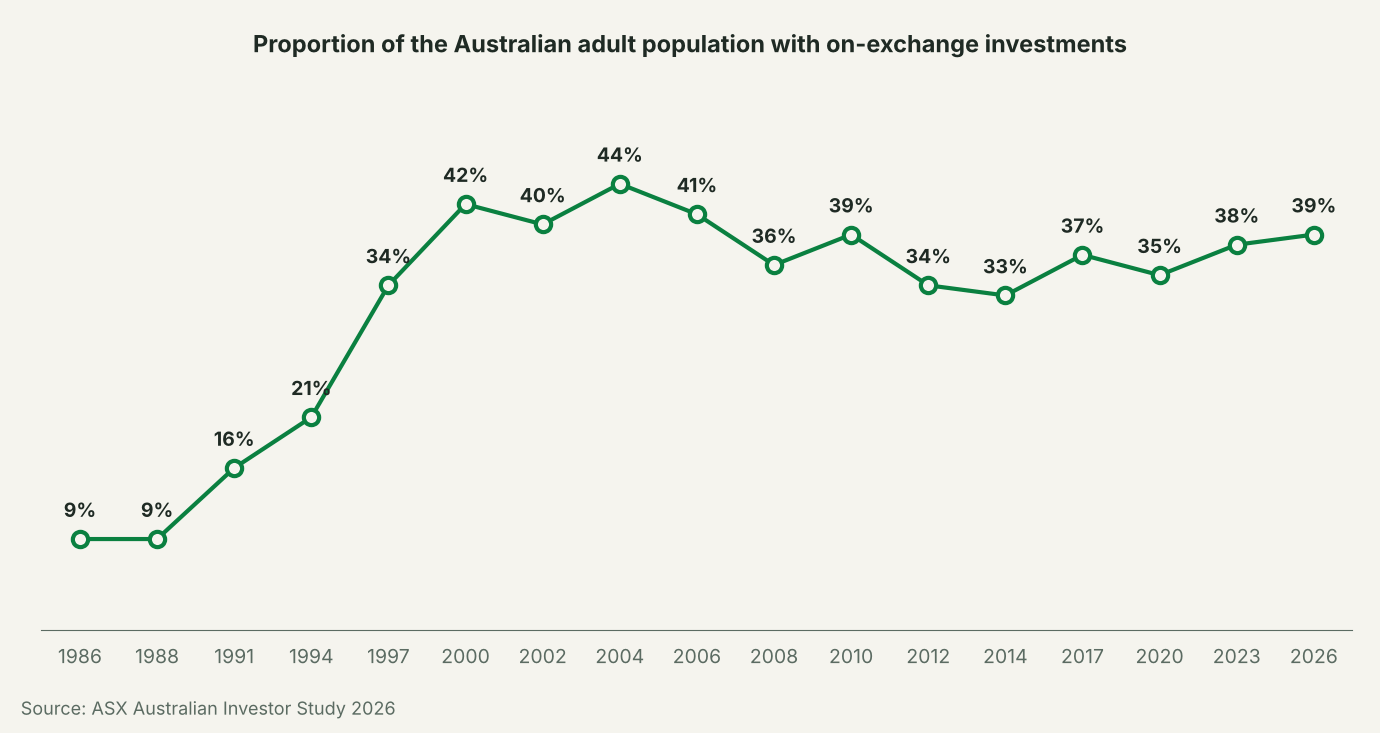
While data on levels of share ownership in the post-war decades is scarce, it was almost certainly low, with bank deposits and government bonds the dominant investment options for households. Even by the late 1980s, only around 9% of Australians owned shares.
In 1986, the ASX began tracking share ownership through its Australian Share Ownership Study, now renamed the Australian Investor Study, which is published every two to three years, most recently in October 2026.
The ASX’s data tells a striking story. While share ownership stood at only 9% of adults in 1988, it surged through the 1990s to 42% by 2000. This surge was driven by high-profile listings during the decade, which brought millions of first-time investors into the market.
The trend continued, with ownership of exchange-listed investments peaking in 2004 at 44%. Ownership levels subsequently retreated from this high, reaching a low of 33% in 2014, although well above the levels of the 1980s and early 1990s. It has since recovered to 39% in 2026, the highest level since 2010.
Interestingly, the ASX’s 2014 Investor Study found that although share ownership levels fell overall in the post-GFC period, direct investments in companies fell less sharply than indirect investments (such as managed funds). The study attributed this trend to a desire for more control over investments, observing that this was “… partly because some older investors continued to associate managed funds with losses incurred during the GFC.”
The COVID-19 pandemic sparked a wave of new investors in Australia’s share market as many Australians turned to shares for income amid plunging interest rates and paltry returns on term deposits and other cash investments. The 2023 Australian Investor Study found that nearly a quarter of all share market investors began investing during the pandemic, with total participation rising to 38%.
The ASX's latest Australian Investor Study shows participation remains strong, with 8.3 million Australians owning on-exchange investments in 2025. Women account for 41% of those investors, up from 38% in 2023, and 61% of those intending to start investing in the next 12 months.
Australia’s dividend imputation system
Australia’s dividend imputation system has been pivotal in driving ownership of Australian public companies. Introduced in July 1987, the reform overcame double taxation by giving shareholders franking credits, in recognition of the corporate tax their company had already paid, thereby reducing the tax payable on dividend income. From 2000, shareholders could receive cash refunds for excess franking credits, making franked dividends particularly valuable to retirees and other low-tax investors and providing a further incentive to invest in the local share market.
The imputation system also saw companies adjust their behaviour. Because Australian shareholders value franked dividends, many companies pay out a higher proportion of their profits as dividends than companies in other developed economies, so that they can distribute franking credits.
Large privatisations
The 1990s were a transformative decade for Australian share ownership. Several large, high-profile public assets, including the Commonwealth Bank and Telstra, were floated on the ASX. In addition, AMP’s demutualisation automatically converted policyholders into shareholders overnight. Other notable IPOs during the decade included CSL, Qantas and Government Insurance Office.
These companies were household names, and their familiarity and strong public awareness of their businesses helped attract millions of first-time investors.
Superannuation and the rise of SMSFs
Another notable development around this time was the introduction of the superannuation guarantee in 1992. Through Australia’s super system, most working Australians became investors in the share market, whether they realised it or not. Due to the superannuation guarantee, as well as favourable tax treatment for superannuation assets, Australians’ super savings have grown to become one of the world's largest pools of capital, at almost $4.8 trillion.
Around $1.1 trillion of that capital is held in self-managed superannuation funds, with Australian company shares the preferred asset class for many trustees, who regard the franked dividends they offer as the cornerstone of their retirement income. A record 48,464 SMSFs were established in 2025, and one in five non-SMSF investors are considering one.
Information increases exponentially
Not so long ago, shareholders heard from companies only a handful of times each year: at the AGM and in the half-year and full-year results, and in an annual report of perhaps a dozen pages. This started to change with the introduction of continuous disclosure rules in 1994, which required companies to promptly update the market on developments that may materially affect their share price. However, many companies now go above and beyond these requirements, publishing newsletters, blogs and videos and hosting investor roadshows to attract capital and engage existing and prospective shareholders.
The financial media and market information ecosystem has also grown substantially and become highly diverse in recent years. Whereas investors previously drew their finance and investing knowledge from a handful of traditional media sources and perhaps their broker, accountant or adviser, there are now a multitude of (largely digital) options, including podcasts, finance news platforms, online forums, newsletters, YouTube and other social media platforms. Investors are also turning to artificial intelligence to inform their investment approach. The ASX found that 10% of investors turn to AI when making investment decisions, while 24% of young investors (aged 18 to 29 years) use AI tools.
Increased understanding of and education about shares is a positive overall; however, retail investors need to be aware of the risks. ASIC recently highlighted its concerns about “the influence of financial information online, particularly among younger Australians.” The regulator issued warning notices against several ‘finfluencers’ it suspected had provided unlicensed financial advice or engaged in misleading or deceptive conduct.
Many online information sources have business models that are more opaque than traditional media, and they do not always disclose whether they have a commercial arrangement with the company, investment product, or market commentator they feature, for example, on their podcast or platform.
Access improvements
Access to the market itself has been transformed in recent years. For most of the last 80 years, buying shares meant calling a broker to place an order and paying a sizeable commission (brokerage). In the late 1990s, online broking platforms emerged, offering everyday Australians the opportunity to invest in shares for a small, often fixed, fee and a low minimum investment. Today, the retail online broking space is highly competitive, leading to some online brokers and platforms offering ultra-low or zero brokerage and trading via smartphone apps.
Exchange-traded funds (ETFs) have also increased the appeal and accessibility of ASX investing. Providing easy exposure to a range of asset classes, investment themes, and geographies, as well as Australian companies, ETFs have surged in popularity, with a combined market capitalisation of approximately $380 billion, up from just $65 billion at the start of this decade. Some 2.82 million Australians now hold ETFs, more than double the 2020 figure, and they are more popular among younger investors, with 31% of those aged 18 to 29 owning them, versus 24% of all investors.
Looking ahead: the next generation of investors
Recent trading account data from CommSec, Australia’s largest online broking platform, revealed that younger Australians are embracing exchange-listed investments. While their Baby Boomer parents and grandparents may have larger portfolios by value, the generations that follow make up the largest share of investors. Millennials (aged 30 to 45 years) are the single largest cohort, accounting for 37% of all investors. Furthermore, Gen Z (aged 14 to 29 years) account for 19% of investors, outnumbering Baby Boomers (17%) according to CommSec.
Younger investors tend to be highly engaged and digitally able, having come of age with low barriers to entry, instant information and a wide choice of listed investment options, including ASX-listed products that give retail investors exposure to asset classes previously out of reach.
The impending intergenerational transfer of wealth over the coming decades may further lift participation, while technology, including AI, will likely continue to reshape how investors research and trade.
Tax settings are also shifting with significant changes announced in this year’s Federal Budget. Legislation passed in June 2026 replaces the 50% capital gains tax discount with inflation indexation and a 30% minimum tax on gains accruing from 1 July 2027. While the full effect of these changes on Australians’ investing decisions remains to be seen, some commentators expect shares to be favoured over property investments.
Primary principles remain unchanged
Although the investing landscape has changed dramatically for shareholders over the last 80 years, with numerous market cycles and disruptive events along the way, we believe the fundamental principles for generating and preserving wealth through Australian shares remain constant. Diversification, a disciplined approach, a focus on fundamentals and reinvesting dividends are just as important today as they were in 1946. Perhaps the most important principle of all is to take a long-term view: time and patience may be a retail investor’s greatest assets.
Note to readers: In this article, the terms shares, on-exchange investments and exchange-traded investments are used interchangeably. Historically, shares were the predominant form of investment available via Australia’s share market. However, in more recent times, other listed products, including real estate investment trusts (REITs) and exchange-traded funds (ETFs), have become popular ASX-listed investments.
Older ASX studies measured share ownership, although this referred to shares as well as other exchange-listed investments. Since 2017, the ASX Study has referred to on-exchange investments.